
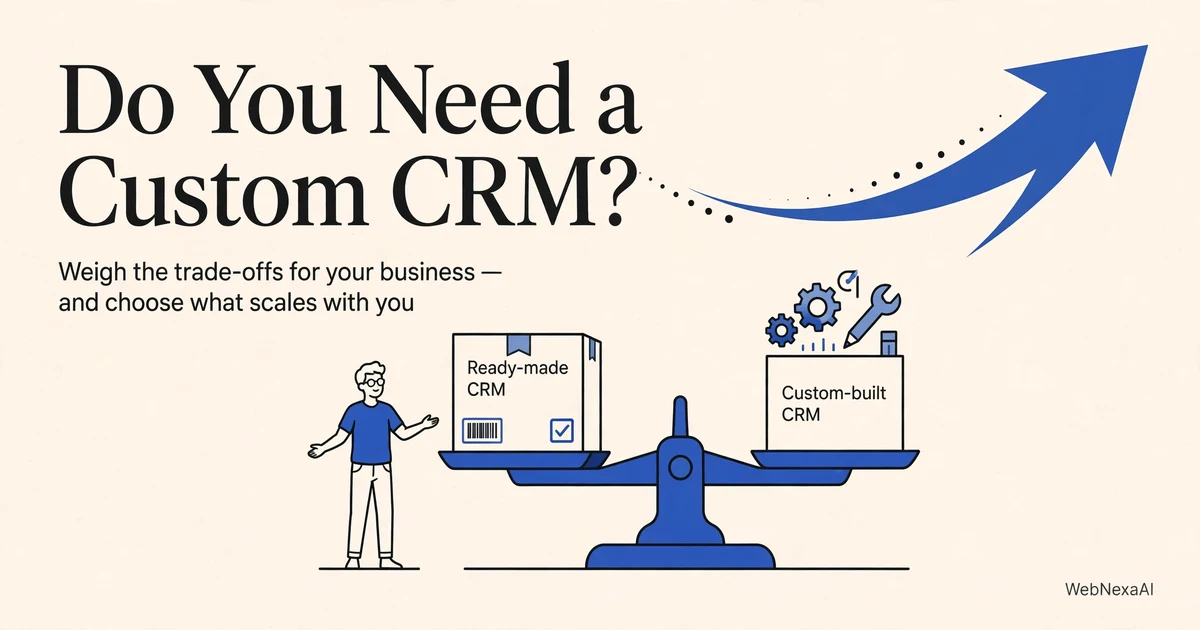
The short answer: most small businesses do not need a custom CRM. They need the CRM they already pay for set up properly, connected, and used every day. A custom CRM earns its place only when the off the shelf tool costs more than a build would, in fees, in workarounds, or in lost leads. That moment is real, but building early is how you end up paying twice.
What is a custom CRM, really?
A custom CRM is software built around your own customer records, pipeline stages, and rules, instead of a product you rent and bend your process to fit. You own the code and the data, there is no per seat fee, and every screen does what your team needs, nothing more.
The difference that matters is not features. It is who adapts to whom. With an off the shelf CRM, HubSpot, Salesforce, Zoho, or GoHighLevel, your team adapts to the product. With a custom build, the product adapts to your team. That sounds better until you remember your process is probably still changing, and a custom build freezes it at the moment you scope it.
When should you keep the CRM you already have?
Keep the CRM you have when it fits. Your team uses it. The features you pay for are mostly the features you use. Your seat count is small and steady. Getting your data out is painless. If those four are true, a custom build is a solution looking for a problem.
The most common fix is not a new system at all. It is finishing the setup of the one you have. Most small business CRMs we see run at a fraction of what they can do: no automated follow up after a missed call, no round robin assignment, no reminder when a quote goes unanswered. The team blames the tool for an unfinished setup. Our GoHighLevel setup work exists for exactly this reason.
The second fix is connecting one missing piece. If your CRM handles the pipeline fine but cannot see your bookings, calls, or WhatsApp conversations, an integration usually closes the gap for a fraction of a build. Configure if your stages fit and were only set up badly. Connect if one step is odd. Build only when no product fits your process. And if your pitch still changes every few months, you do not know what to build yet.
What are the signs your CRM has stopped fitting?
A CRM does not fail you all at once. It charges a little more and fits a little worse every year. Three or more at once is the signal.
Per seat creep. At $90 a seat, 25 users cost $27,000 a year. If 17 of those 25 only update a status, most of that money pays for features never opened. HubSpot's Sales Hub Professional is $90 to $100 per seat per month, plus a $1,500 onboarding fee.
The shadow spreadsheet. When your team keeps a sheet next to the CRM because the CRM cannot show what they need, that sheet is your missing feature list. If the shadow system is running half your operation, the rental is not working.
Locked exports. If getting your own customer data out needs a higher tier or a support ticket, you are renting your own business records. A custom CRM exports by default, because the database is yours.
Workflow contortions. Approvals through three people in a chat app, quotes in another tool, follow ups on paper. The CRM describes how a generic company sells. Your team translates in real time. The same goes for automation that keeps breaking: chains of zaps that fail every other week mean the system was assembled, not designed. A custom build replaces five fragile connections with one direct flow, the same thinking behind our CRM automation examples built in n8n.

How much does a custom CRM cost compared to a subscription?
Never compare one invoice against one build. Compare three years of subscription against three years of owning, including hosting, maintenance, and the small changes every CRM generates in its first quarter of use.
For a small team, the subscription almost always wins. A four person team at roughly $90 per user per month pays about $4,320 a year, or roughly $13,000 over three years. A focused custom CRM build typically runs $3,000 to $15,000, the range we publish on our custom CRM and dashboards page, before hosting and maintenance. Below about ten users, the licence line never justifies a build.
Between ten and twenty five users, it is genuinely close and worth doing the arithmetic. Above twenty five, with real integrations the product cannot express, a phased build usually wins over thirty six months. At $90 a seat, 25 users cost $81,000 over three years, against a build that might cost a fifth of that. What moves a build price is not headcount. It is integrations, data migration, reporting depth, and workflow complexity. Indian market guides put a focused build at roughly ₹2,00,000 to ₹5,00,000. Anyone giving a firm number before understanding your workflow is guessing.
What does a first custom CRM actually need?
Less than you think. A first version needs six parts: contacts and companies, your own pipeline, activity and tasks, roles and permissions, search and import, and one or two connections. Everything else is a second release.
The temptation is to rebuild Salesforce. Resist it. A right sized custom CRM skips the 80 percent of enterprise features you would never touch. Start the scope from the spreadsheet next to your CRM. Its columns are the fields your team uses. Build that, wire it into lead capture, and connect the follow up. That is the core of the system we build for clients: enquiries in, AI follow up out, booked calls on the calendar. Our AI lead generation work runs on the same idea. The CRM is not the goal. The booked call is.
When should you definitely not build one?
Do not build with under about five users on a standard pipeline. Do not build if your process is unwritten, because a build freezes a process nobody has agreed on. Do not build if nobody will own the system after launch. And do not build if you need a native mobile app, because that is a second product, not a feature.
One more case owners rarely admit: the problem is discipline, not software. If nobody updates the current CRM, a custom one will not fix that. The fix is automating the follow ups so the system updates itself. A CRM nobody opens is a CRM nobody opens, whatever you paid to build it.
How do you decide, in one afternoon?
Ask five questions, in order, and take the first answer that stops you. One, does a well matched off the shelf or vertical tool cover 90 percent of your workflow? For home services, Jobber or ServiceTitan were designed around exactly that work. Two, is your team using the current system? If no, fix the process first. Three, are you paying for tiers or seats far beyond what you use? If the three year subscription cost is approaching a build, custom is probably cheaper within two years. Four, is a shadow system of spreadsheets running a real part of your operation? If yes, the rental has failed, and the spreadsheet is your scope document. Five, is your process what makes you different?
A real estate agency we worked with booked 313 percent more appointments after we rebuilt the lead journey around their process, with an instant call bridge from agent to lead. The build was justified because the process was the advantage.
If you get through all five and the answer is still build, then build small. One pipeline, one integration, one team using it daily. If any question stops you, the answer is configure, connect, or wait. If you want that call made on your actual numbers, book a discovery call and we will run the three year maths with you.
Frequently asked questions
Do small businesses need a custom CRM?
Usually not at first. Most small businesses are better served keeping the CRM they already know. A custom CRM earns its place once per seat pricing, locked exports, or daily workarounds start costing more than the build would.
How much does a custom CRM cost for a small business?
A focused custom CRM typically costs $3,000 to $15,000 to build, the range we publish on our custom CRM page, plus hosting and maintenance each year. Indian market guides put a focused build at roughly ₹2,00,000 to ₹5,00,000. The honest figure comes after discovery, not before it.
Is a custom CRM cheaper than HubSpot or Salesforce over time?
Below about ten users, no. A subscription is cheaper over three years and available immediately. Between ten and twenty five it is close. Above twenty five, with real integrations the product cannot express, a phased build usually wins over thirty six months, because subscriptions charge per seat forever and a build does not.
What should a first custom CRM include?
Six parts: contacts and companies, your own pipeline, activity and tasks, roles and permissions, search and import, and one or two connections. Start from the spreadsheet next to your CRM. Its columns show exactly what the current tool is missing.
Should I build a custom CRM or set up GoHighLevel?
Set up GoHighLevel first. Most businesses that think they have outgrown it have only outgrown a bad setup. If it still cannot express your process after a proper setup, a custom build is the honest next step.